Getting traffic to your website feels great until you realize most visitors leave without buying anything. They browse, click around, and disappear forever. Where did they go? More importantly, how do you bring them back?
A sales funnel solves this problem by guiding potential customers through a deliberate journey from awareness to purchase. Instead of hoping visitors buy on their first visit, you nurture the relationship until they are ready. Learning how to build a sales funnel is one of the most valuable skills any business owner can develop.
This guide walks you through creating a sales funnel from scratch. We cover each stage, the tools you need, and common mistakes to avoid. By the end, you will have a clear blueprint for converting more visitors into paying customers. Let’s start building.
Key Takeaways
- Understand the four stages of a sales funnel.
- Learn how to create content for each funnel stage.
- Discover tools that automate funnel management.
- Find out how to measure funnel performance.
- Get practical tips for optimizing conversion rates.
- Avoid common mistakes that kill funnel effectiveness.
What is a Sales Funnel?
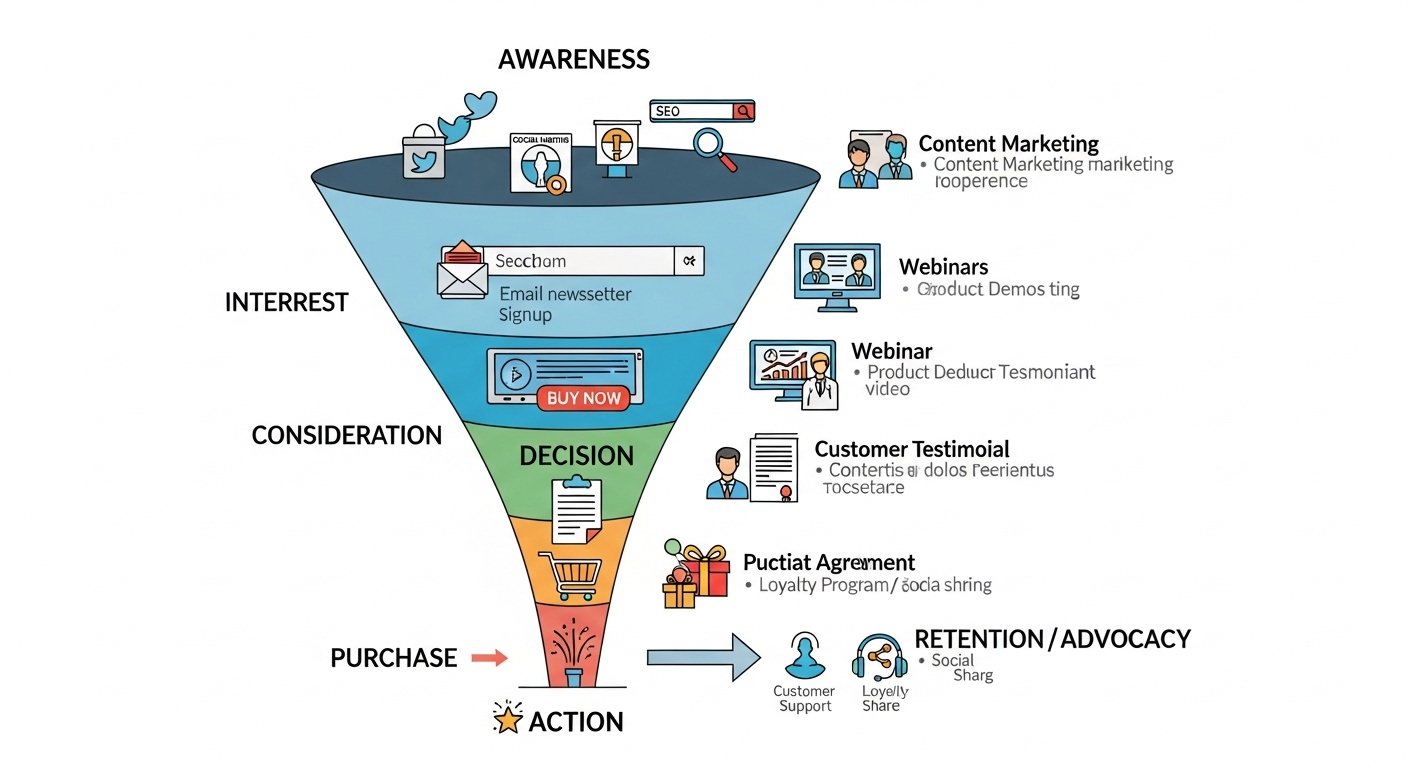
A sales funnel is the path potential customers take from first discovering your business to making a purchase. It is called a funnel because more people enter at the top than make it to the bottom. At each stage, some people drop off while others move closer to buying.
The Four Stages
| Stage | Customer Mindset | Your Goal |
|---|---|---|
| Awareness | Just discovered you | Attract attention |
| Interest | Curious about your offer | Build engagement |
| Decision | Evaluating options | Convince to buy |
| Action | Ready to purchase | Close the sale |
Understanding these stages helps you create the right content and offers at the right time. Pushing for a sale too early scares people away. Waiting too long means losing them to competitors.
Stage 1: Awareness
The awareness stage is where people first learn about your business. They have a problem or need, and they are searching for solutions. Your job is to get in front of them and make a positive first impression.
Awareness Strategies
- Blog content: Write articles that answer common questions in your industry
- Social media: Share valuable content that attracts your target audience
- SEO: Optimize your website to appear in search results
- Paid ads: Run targeted ads on Google or social media platforms
- Guest posting: Write for other websites to reach new audiences
Content Types for Awareness
At this stage, focus on educational content that helps without selling:
- How-to guides and tutorials
- Industry news and trends
- Problem-solving articles
- Infographics and visual content
- Videos explaining concepts
Stage 2: Interest
Once people know you exist, you need to keep their attention. The interest stage is about building a relationship and establishing trust. People are evaluating whether you can actually help them.
Building Interest
- Email list: Offer something valuable in exchange for email addresses
- Lead magnets: Free ebooks, checklists, templates, or tools
- Webinars: Live or recorded presentations on relevant topics
- Case studies: Show how you have helped others succeed
- Social proof: Display testimonials and reviews
Lead Magnet Ideas
Your lead magnet should solve a specific problem and demonstrate your expertise:
- Free checklist or cheat sheet
- Template or spreadsheet
- Mini-course delivered by email
- Free tool or calculator
- Exclusive video training
Stage 3: Decision
At the decision stage, people are seriously considering your offer. They are comparing you with alternatives and looking for reasons to choose you. Your job is to make the decision easy.
Helping People Decide
- Detailed product information: Clear descriptions, features, and benefits
- Comparison guides: Show how you stack up against competitors
- Free trials: Let people experience your product risk-free
- Demos: Show your product in action
- FAQ pages: Address common concerns and objections
Overcoming Objections
Common objections include price, trust, and timing. Address these proactively:
- Price: Show value and ROI, offer payment plans
- Trust: Provide guarantees, testimonials, and case studies
- Timing: Create urgency with limited-time offers
- Risk: Offer free trials or money-back guarantees
Stage 4: Action
The action stage is where the sale happens. Make this process as smooth as possible. Any friction at this point can lose a customer who was ready to buy.
Optimizing for Conversions
- Simple checkout: Minimize steps required to complete purchase
- Multiple payment options: Accept credit cards, PayPal, and other methods
- Clear pricing: No hidden fees or surprises at checkout
- Trust signals: Display security badges and guarantees
- Mobile-friendly: Ensure checkout works perfectly on phones
Post-Purchase Follow-Up
The funnel does not end at purchase. Follow up to ensure satisfaction and encourage repeat business:
- Send order confirmation immediately
- Provide clear next steps or onboarding
- Check in after delivery to ensure satisfaction
- Ask for reviews and referrals
- Offer related products or upgrades
Tools for Building Sales Funnels
The right tools make funnel building much easier. Here are the best options for different needs.
All-in-One Funnel Builders
- ClickFunnels: Purpose-built for creating sales funnels with drag-and-drop simplicity
- Leadpages: Excellent landing pages with built-in conversion tools
- Kartra: Comprehensive platform with email, membership sites, and more
Email Marketing Platforms
- ConvertKit: Built for creators with powerful automation
- ActiveCampaign: Advanced automation with CRM capabilities
- Mailchimp: User-friendly with good free tier
Landing Page Builders
- Unbounce: Advanced A/B testing and optimization features
- Instapage: Easy to use with strong collaboration tools
- Carrd: Simple, affordable single-page sites
Measuring Funnel Performance
Track these metrics to understand how your funnel is performing and where to improve.
Key Metrics
| Metric | What It Measures | Good Benchmark |
|---|---|---|
| Conversion Rate | Visitors who become leads | 2-5% |
| Lead-to-Customer Rate | Leads who become customers | 1-3% |
| Cost Per Lead | Acquisition cost for each lead | Varies by industry |
| Customer Lifetime Value | Total revenue per customer | 3x acquisition cost |
Where People Drop Off
Identify where people leave your funnel and focus improvement efforts there:
- High traffic but low leads: Improve your lead magnet or call-to-action
- Good leads but few sales: Strengthen your decision-stage content
- Cart abandonment: Simplify checkout and reduce friction
- One-time buyers: Improve post-purchase follow-up
Common Funnel Mistakes
Avoid these pitfalls that can sabotage your funnel effectiveness.
Selling Too Early
Pushing for a sale before building trust is the most common mistake. People need to know, like, and trust you before they buy. Respect the journey and nurture relationships first.
Ignoring Mobile Users
More than half of web traffic comes from mobile devices. If your funnel does not work perfectly on phones, you are losing customers. Test every element on mobile before launching.
Not Following Up
Most people do not buy on their first visit. Without follow-up, you lose them forever. Email sequences and retargeting ads bring people back when they are ready.
Overcomplicating Things
Simple funnels often outperform complex ones. Start with a basic funnel and optimize based on data. Add complexity only when you have evidence it will improve results.
Conclusion
Knowing how to build a sales funnel gives you a systematic approach to converting visitors into customers. Instead of hoping for random purchases, you guide people through a deliberate journey that builds trust and addresses their needs.
Start with a simple funnel covering all four stages. Measure performance, identify weak points, and improve continuously. The businesses with the best funnels are not the ones that built them perfectly from the start. They are the ones that tested, learned, and optimized relentlessly.
Your funnel will never be perfect, but it can always be better. Start building today and watch your conversions grow.
FAQ
What is the difference between a sales funnel and a marketing funnel?
A marketing funnel focuses on awareness and lead generation, while a sales funnel covers the entire journey from first contact to purchase and beyond. Some businesses use the terms interchangeably, but a sales funnel typically includes post-purchase follow-up and customer retention strategies.
How long should a sales funnel be?
The length depends on your product price and complexity. Low-cost impulse purchases might have a funnel lasting minutes or hours. High-ticket B2B sales can take months. Most small business funnels span one to four weeks from awareness to purchase. Focus on providing value at each stage rather than rushing the process.
What is a good conversion rate for a sales funnel?
Overall funnel conversion rates vary widely by industry, but 1-3% from visitor to customer is typical for most small businesses. Top performers achieve 5% or higher. Focus on improving each stage rather than the overall number. Even small improvements at each stage compound into significant results.
Do I need expensive software to build a sales funnel?
No, you can build effective funnels with affordable or free tools. A simple website, email marketing platform, and landing page builder are enough to start. Tools like Mailchimp, WordPress, and free landing page builders work well for beginners. Upgrade to specialized funnel software only when your needs demand it.
How do I drive traffic to my sales funnel?
Drive traffic through content marketing, SEO, social media, paid advertising, email marketing, and partnerships. The best approach combines multiple channels. Start with organic methods like blogging and social media, then add paid advertising as you understand what works. Always track which channels deliver the best return on investment.
What is the most important part of a sales funnel?
The lead capture stage is often the most critical because it converts anonymous visitors into identifiable contacts you can follow up with. Without capturing leads, you have no way to nurture relationships with people who are not ready to buy immediately. Focus on creating compelling lead magnets that genuinely help y