Running a business means juggling a hundred different things at once. Customers need attention, inventory needs tracking, and finances need managing. Software promises to help, but the options can feel endless and confusing.
Two of the most common business software terms you will hear are CRM and ERP. They sound similar, serve different purposes, and choosing the wrong one can waste thousands of dollars. Understanding the difference between CRM and ERP systems is crucial for making the right investment.
This guide explains exactly what each system does, who needs which, and how to decide based on your business stage and goals. By the end, you will know precisely which solution fits your situation. No more confusion.
Key Takeaways
- Understand the core difference between CRM and ERP systems.
- Learn which business functions each system handles.
- Discover when your business needs one versus the other.
- Compare costs, implementation time, and complexity.
- Find out how CRM and ERP can work together.
- Get clear recommendations based on business size and industry.
What is a CRM System?
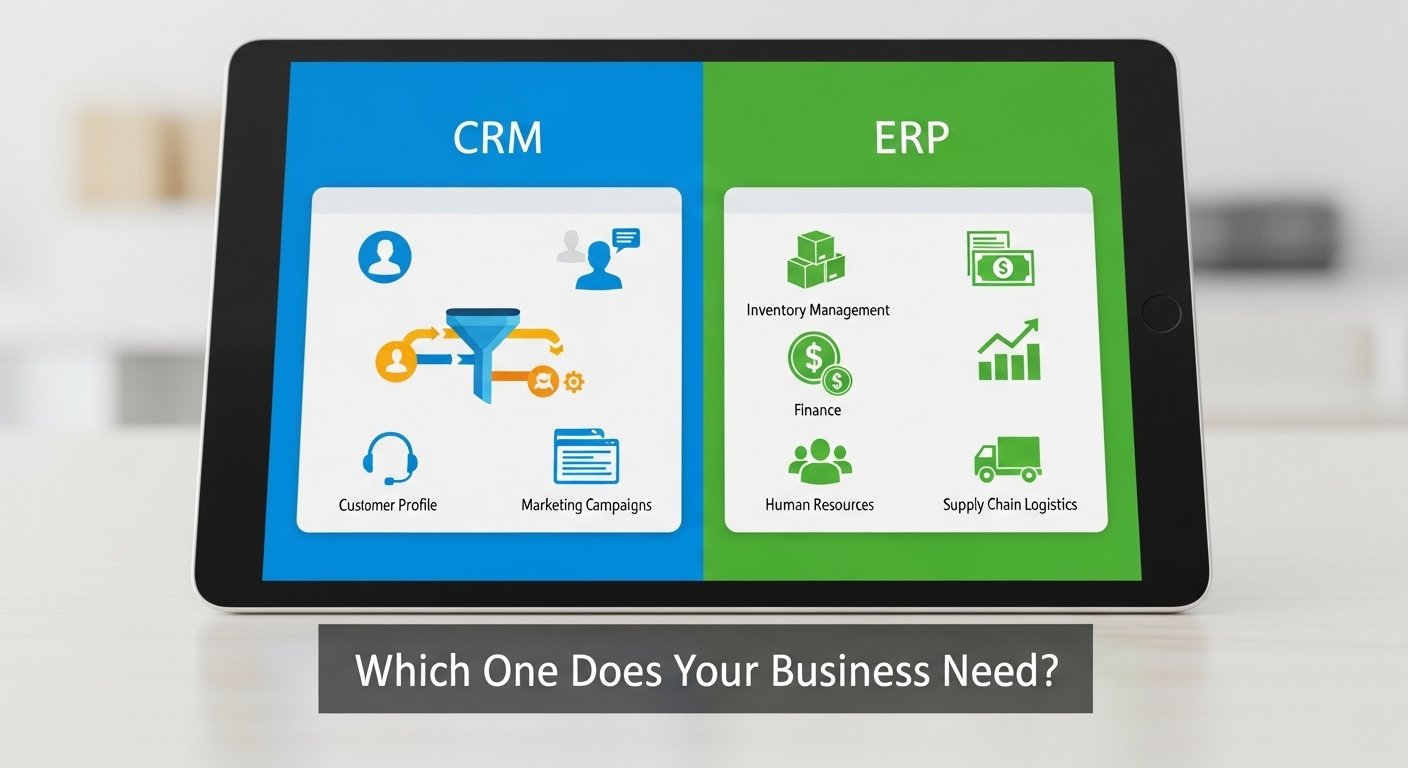
CRM stands for Customer Relationship Management. At its core, a CRM helps you manage interactions with current and potential customers. Think of it as your digital address book on steroids.
A CRM tracks every touchpoint in the customer journey. From the first email a prospect opens to the final purchase and beyond, everything gets recorded in one place. This creates a complete picture of each customer relationship.
Core CRM Functions
- Contact Management: Store customer information, communication history, and preferences.
- Sales Pipeline: Track deals from initial contact to closed sale.
- Marketing Automation: Send targeted emails and track campaign performance.
- Customer Service: Manage support tickets and track resolution times.
- Analytics: Measure sales performance and customer engagement.
Who Uses CRM?
Sales teams, marketing departments, and customer service representatives rely on CRM daily. If your business involves selling products or services and maintaining customer relationships, a CRM is essential.
Common industries that benefit from CRM include:
- E-commerce and retail
- Real estate
- Financial services
- Professional services like consulting and law
- Healthcare providers
What is an ERP System?
ERP stands for Enterprise Resource Planning. While CRM focuses on external relationships, ERP manages internal business processes. It is the backbone that connects finance, operations, human resources, and supply chain into one unified system.
An ERP eliminates data silos by creating a single source of truth for all business operations. When the sales team closes a deal, the finance team sees the invoice, the warehouse sees the shipping request, and management sees the revenue update. Everything flows automatically.
Core ERP Functions
- Financial Management: Accounting, budgeting, and financial reporting.
- Supply Chain: Inventory management, procurement, and logistics.
- Human Resources: Payroll, benefits, and employee records.
- Manufacturing: Production planning, quality control, and scheduling.
- Project Management: Resource allocation and project tracking.
Who Uses ERP?
Operations managers, finance teams, warehouse staff, and executives use ERP systems. If your business involves managing inventory, processing orders, or handling complex operations, an ERP becomes necessary.
Common industries that need ERP include:
- Manufacturing
- Distribution and wholesale
- Construction
- Healthcare organizations
- Large retail chains
CRM vs ERP: Key Differences
Now that you understand what each system does, let us compare them directly. The table below highlights the fundamental differences.
| Aspect | CRM | ERP |
|---|---|---|
| Primary Focus | Customer relationships | Business operations |
| Main Users | Sales, marketing, support | Finance, operations, HR |
| Key Data | Contacts, deals, interactions | Financials, inventory, orders |
| Goal | Increase revenue | Reduce costs and improve efficiency |
| Implementation Time | Days to weeks | Months to years |
| Typical Cost | $10-150 per user/month | $10,000-500,000+ |
| Complexity | Low to moderate | Moderate to very high |
Revenue vs Efficiency
The simplest way to remember the difference: CRM helps you make money by winning and keeping customers. ERP helps you save money by running operations more efficiently. Both are valuable, but they solve different problems.
A CRM asks: “How do we sell more?”
An ERP asks: “How do we deliver what we sold efficiently?”
External vs Internal
CRM looks outward at customers, prospects, and market opportunities. ERP looks inward at processes, resources, and workflows. This fundamental difference determines which system you need first.
When Do You Need a CRM?
A CRM should be your first investment if you recognize any of these situations in your business.
Signs You Need a CRM
- You are losing track of customer conversations and follow-ups
- Sales forecasting feels like guesswork
- Multiple team members contact the same lead without coordination
- Customer information is scattered across emails and spreadsheets
- You want to scale your sales efforts systematically
Business Stage for CRM
Most businesses benefit from a CRM once they have more than a handful of customers to manage. Even solo entrepreneurs and freelancers find value in organizing their client relationships. You do not need to wait until you have a large team.
Typical CRM adoption timeline:
- 0-10 customers: Spreadsheets work fine
- 10-50 customers: Basic CRM becomes helpful
- 50-500 customers: CRM is essential
- 500+ customers: Advanced CRM with automation needed
When Do You Need an ERP?
An ERP becomes necessary when your business operations grow too complex for separate tools to handle effectively.
Signs You Need an ERP
- Your finance team spends days reconciling data from different systems
- Inventory counts never match what your system shows
- Order processing involves manual steps across multiple tools
- Generating reports requires pulling data from five different places
- Compliance and audit requirements are becoming difficult to meet
Business Stage for ERP
ERP systems are typically adopted by established businesses with complex operations. The investment is significant, so you need sufficient revenue and operational complexity to justify the cost.
Typical ERP adoption indicators:
- Annual revenue under $1 million: ERP usually not needed
- $1-10 million revenue: Consider basic ERP if operations are complex
- $10-50 million revenue: ERP becomes increasingly important
- $50+ million revenue: ERP is typically essential
Can You Use Both CRM and ERP?
The short answer is yes, and many successful businesses do exactly that. CRM and ERP are not competing systems. They complement each other by handling different aspects of your business.
How CRM and ERP Work Together
When integrated properly, CRM and ERP create a seamless flow from customer acquisition to order fulfillment:
- Sales team uses CRM to close a deal
- Order automatically flows to ERP for processing
- ERP manages inventory, shipping, and invoicing
- Customer data syncs back to CRM for future engagement
This integration eliminates duplicate data entry, reduces errors, and gives everyone visibility into the complete customer lifecycle.
Integration Considerations
Connecting CRM and ERP requires careful planning. Consider these factors:
- Data Mapping: Ensure customer and product data matches between systems.
- Sync Frequency: Decide if data should sync in real-time or on a schedule.
- User Permissions: Control who can access what information in each system.
- Error Handling: Plan for what happens when sync fails.
Popular CRM Options
If you have determined that a CRM is what you need, here are the top options to consider.
Salesforce
The market leader with comprehensive features for businesses of all sizes. Best for companies that need advanced customization and have the budget for it.
HubSpot CRM
Offers a free tier that is genuinely useful. Perfect for startups and small businesses that want to get started without upfront costs.
Zoho CRM
Provides excellent value with affordable pricing and a wide feature set. Great for budget-conscious businesses that still want powerful capabilities.
Pipedrive
Focused specifically on sales pipeline management. Ideal for sales teams that want a simple, visual way to track deals.
Popular ERP Options
If an ERP is the right choice, consider these established platforms.
SAP
The gold standard for large enterprises. Offers unmatched depth and customization but requires significant investment and implementation time.
Oracle NetSuite
A cloud-based ERP that balances functionality with accessibility. Popular among mid-sized businesses that need robust capabilities without on-premise infrastructure.
Microsoft Dynamics 365
Combines CRM and ERP functionality in one platform. Excellent choice if you want both systems from a single vendor with native integration.
Odoo
An open-source option that is highly customizable and affordable. Best for businesses with technical resources that want flexibility.
Making Your Decision
Choosing between CRM and ERP comes down to understanding your most pressing business challenges. Use this simple decision framework.
Choose CRM First If:
- Your biggest challenge is winning and retaining customers
- Sales processes are disorganized
- You need better visibility into your sales pipeline
- Marketing efforts lack coordination
- Customer service needs improvement
Choose ERP First If:
- Operational inefficiencies are your biggest pain point
- Financial reporting takes too long
- Inventory management is causing problems
- You need better control over costs
- Compliance requirements are demanding
Consider Both If:
- Your business has grown beyond simple operations
- You are losing data between sales and operations
- Manual processes are slowing everything down
- You have the budget for a comprehensive solution
Conclusion
Understanding the difference between CRM and ERP systems empowers you to make smart software investments. CRM helps you win customers and grow revenue. ERP helps you run operations efficiently and control costs. Both are valuable, but they solve different problems.
Start by identifying your most urgent business challenge. If customers and sales are the priority, begin with a CRM. If operations and efficiency need attention, consider an ERP. And as your business grows, remember that these systems work best when they work together.
The right software does not just solve today’s problems. It creates a foundation for sustainable growth. Choose wisely, implement thoughtfully, and watch your business thrive. The investment will pay for itself many times over.
FAQ
What is the main difference between CRM and ERP?
The main difference is their focus. CRM manages customer relationships and sales processes to help you generate revenue. ERP manages internal business operations like finance, inventory, and HR to help you reduce costs and improve efficiency. CRM looks outward at customers while ERP looks inward at operations.
Can a small business use ERP?
Small businesses can use ERP, but it is usually not necessary until operations become complex. Most small businesses start with a CRM and basic accounting software. Consider ERP when you have multiple departments, significant inventory, or annual revenue exceeding $1 million with complex operational needs.
Is Microsoft Dynamics both a CRM and ERP?
Yes, Microsoft Dynamics 365 offers both CRM and ERP capabilities in a single platform. This makes it an excellent choice for businesses that want integrated customer relationship management and enterprise resource planning without connecting separate systems. The native integration between modules creates a seamless experience.
How much does an ERP system cost compared to CRM?
ERP systems are significantly more expensive than CRM. A typical CRM costs $10-150 per user per month, while ERP implementations can range from $10,000 to $500,000 or more depending on complexity. ERP also requires longer implementation times, often taking months or even years for large organizations.
Do I need both CRM and ERP for my business?
Many businesses eventually need both, but you do not need to implement them simultaneously. Start with the system that addresses your most pressing need. If sales and customer management are the priority, begin with CRM. If operational efficiency is the challenge, start with ERP. As your business grows, integrate both systems for maximum benefit.
Which industries need ERP the most?
Industries with complex operations benefit most from ERP, including manufacturing, distribution, construction, healthcare, and large retail. These industries deal with inventory management, supply chain coordination, regulatory compliance, and complex financial reporting that ERP systems are specifically desig