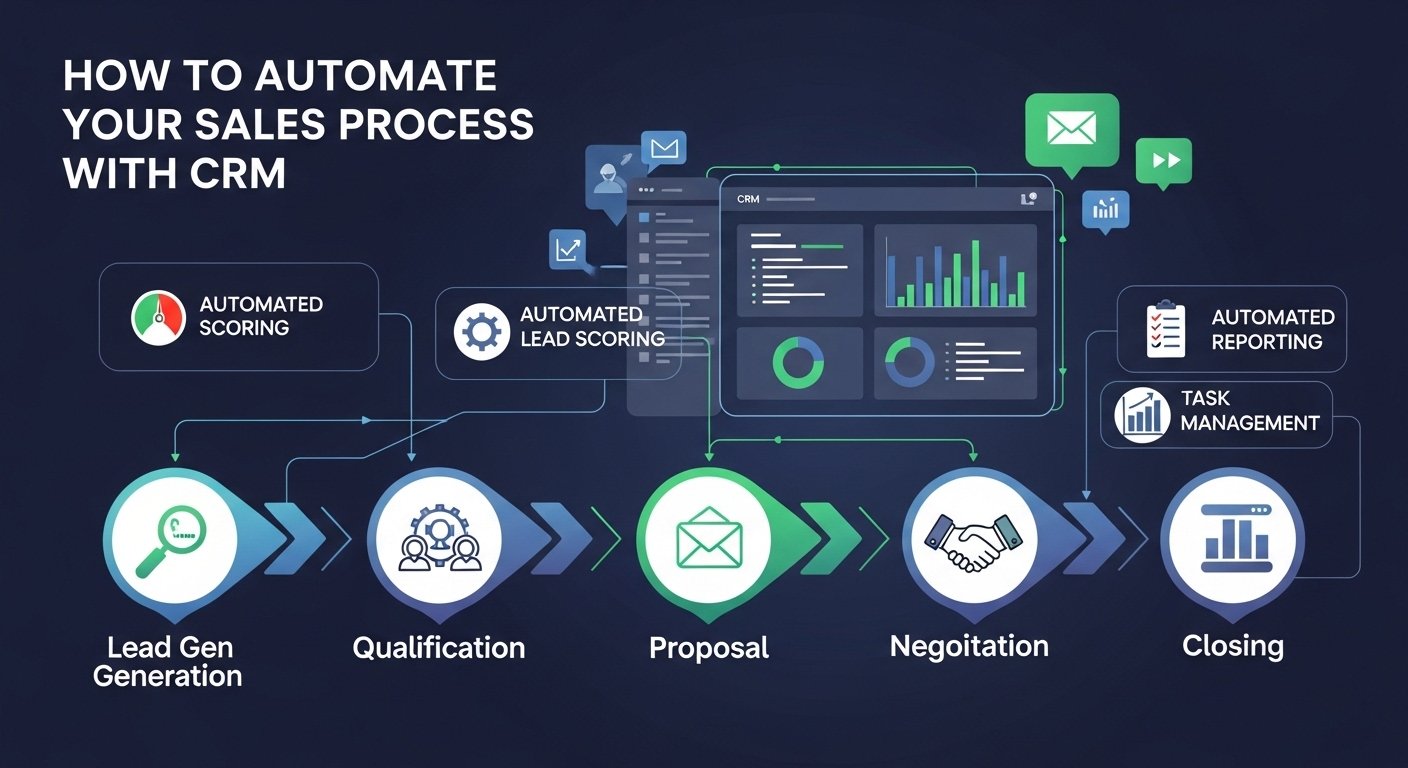
Sales teams spend too much time on tasks that do not actually involve selling. Data entry, follow-up reminders, and manual reporting eat into hours that should be spent closing deals. Automation changes the game entirely.
When you automate your sales process with CRM, repetitive tasks happen automatically while your team focuses on building relationships and winning business. The right automation setup can save each salesperson 10 or more hours per week. That is time you can reinvest into prospecting, demos, and closing.
This guide shows you exactly how to set up sales automation using your CRM. We cover the workflows that deliver the biggest impact, common mistakes to avoid, and step-by-step instructions for getting started. Let’s put your sales on autopilot.
Key Takeaways
- Learn which sales tasks benefit most from automation.
- Discover proven workflows that save time and increase revenue.
- Understand how to set up lead scoring and prioritization.
- Find out how automated follow-ups improve conversion rates.
- Get step-by-step guidance for implementing sales automation.
- Avoid common mistakes that hurt rather than help your sales process.
Why Sales Automation Matters
The average salesperson spends only 34% of their time actually selling. The rest goes to administrative tasks, internal meetings, and manual data entry. This is a massive waste of your most expensive resource.
Sales automation handles the repetitive work so your team can focus on what they do best: building relationships and closing deals. Companies that automate their sales process see an average 10% increase in revenue within the first year.
The Hidden Cost of Manual Processes
Manual sales processes create several problems that compound over time:
- Leads go cold: Without automated follow-ups, prospects wait too long and lose interest.
- Data gets messy: Manual entry leads to errors and incomplete records.
- Reporting takes forever: Pulling together reports manually wastes hours every week.
- Inconsistent experience: Every rep handles things differently, creating confusion.
Studies show that 79% of marketing leads never convert to sales due to lack of proper follow-up. Automation solves this by ensuring no lead falls through the cracks.
Benefits of Sales Automation
When done right, automation delivers measurable results:
- Faster response times to new leads
- Higher conversion rates through consistent follow-up
- More accurate sales forecasting
- Better data quality for decision-making
- Reduced administrative burden on sales reps
- Improved customer experience throughout the sales cycle
Sales Tasks You Should Automate
Not every task should be automated. Focus on repetitive, time-consuming activities that do not require human judgment. Here are the highest-impact areas to start with.
Lead Capture and Assignment
When a new lead comes in through your website, form, or ad, it should automatically enter your CRM and get assigned to the right salesperson. Manual lead distribution creates delays and uneven workloads.
Automation setup:
- Web forms automatically create new contacts in CRM
- Lead scoring assigns priority based on criteria you define
- Round-robin or territory-based assignment distributes leads fairly
- Instant notifications alert the assigned rep
Email Sequences
Automated email sequences nurture leads without manual effort. You create the templates once, and the system sends them at the right intervals based on prospect behavior.
Effective sequence structure:
- Day 0: Welcome email with value proposition
- Day 3: Educational content addressing common pain points
- Day 7: Case study or social proof
- Day 14: Direct call-to-action for meeting or demo
- Day 21: Final follow-up with urgency element
Task Reminders
Automated reminders ensure sales reps never miss a follow-up. The CRM creates tasks based on deal stage changes, time elapsed, or prospect actions.
Smart reminder examples:
- Call reminder when a prospect opens your proposal email
- Follow-up task when no activity occurs for 7 days
- Meeting prep reminder 24 hours before scheduled calls
- Contract renewal alert 30 days before expiration
Data Entry and Updates
Automatically log emails, calls, and meetings to contact records. This eliminates manual data entry and ensures complete activity history.
What to automate:
- Email logging from connected inbox
- Call recording and transcription
- Meeting scheduling and calendar sync
- Deal stage updates based on activities
Reporting and Dashboards
Automated reports deliver key metrics to your inbox on a schedule. No more spending Monday morning pulling together last week’s numbers.
Reports to automate:
- Daily pipeline summary
- Weekly activity metrics by rep
- Monthly revenue forecast
- Win/loss analysis by deal size or source
Setting Up Lead Scoring
Lead scoring helps your team prioritize the hottest prospects. Instead of treating every lead equally, you assign points based on characteristics and behaviors that indicate buying intent.
Demographic Scoring
Points based on who the lead is:
| Criteria | Points | Reasoning |
|---|---|---|
| Matches ideal customer profile | +20 | High fit for your solution |
| Decision maker title | +15 | Authority to purchase |
| Company size matches target | +10 | Budget and need aligned |
| Wrong industry | -10 | Unlikely to convert |
| Student or job seeker | -20 | Not a real prospect |
Behavioral Scoring
Points based on what the lead does:
| Action | Points | Signal Strength |
|---|---|---|
| Visited pricing page | +15 | Strong buying intent |
| Downloaded case study | +10 | Evaluating solutions |
| Opened 3+ emails | +5 | Engaged with content |
| Requested demo | +25 | Ready to buy |
| No activity for 30 days | -10 | Lost interest |
Using Scores for Automation
Once you have scoring set up, use it to trigger actions:
- Score 0-30: Continue nurturing sequence
- Score 31-60: Alert sales rep for personal outreach
- Score 61+: Priority lead, immediate follow-up required
Building Effective Sales Workflows
Workflows are the backbone of sales automation. They define what happens automatically based on triggers and conditions you set.
New Lead Workflow
When a new lead enters your system:
- Create contact record in CRM
- Send welcome email immediately
- Assign to sales rep based on territory or round-robin
- Create follow-up task for rep within 24 hours
- Add to appropriate email nurture sequence
- Score initial lead based on source and demographics
Deal Stage Workflow
When a deal moves to a new stage:
- Update deal value and probability
- Send stage-specific email templates
- Create required tasks for that stage
- Notify relevant team members
- Update forecast reports
Re-engagement Workflow
When a lead goes cold:
- Wait 14 days with no activity
- Send re-engagement email with fresh content
- If no response in 7 days, send second attempt
- If still no response, move to long-term nurture
- Alert rep if high-value opportunity
Choosing the Right CRM for Automation
Not all CRMs handle automation equally. Here are the best options for sales automation specifically.
HubSpot Sales Hub
HubSpot offers powerful automation even on its free plan. Sequences, task automation, and email tracking are included. Paid plans add advanced workflows and predictive lead scoring.
Best For
Small to mid-sized teams that want easy-to-use automation without complexity. HubSpot makes it simple to get started and scale up.
Salesforce
Salesforce provides the most comprehensive automation capabilities through Process Builder and Flow. However, it requires more technical knowledge to set up effectively.
Best For
Larger teams with complex sales processes and dedicated administrators. Salesforce handles sophisticated automation that other tools cannot match.
Pipedrive
Pipedrive focuses on visual pipeline automation. Its workflow builder makes it easy to create automations by dragging and dropping conditions and actions.
Best For
Sales-focused teams that want simple, visual automation. Pipedrive excels at keeping the sales process moving without overcomplicating things.
ActiveCampaign
ActiveCampaign combines CRM with powerful marketing automation. Its automation builder is among the most flexible available, allowing complex multi-step workflows.
Best For
Teams that need tight integration between sales and marketing automation. ActiveCampaign handles both exceptionally well.
Common Automation Mistakes to Avoid
Automation can backfire if implemented poorly. Avoid these common pitfalls.
Over-Automating
Not everything should be automated. Personal relationships require human touch. Use automation for repetitive tasks, but keep high-value interactions personal.
Poor Timing
Sending automated emails at the wrong time reduces effectiveness. Test different send times and consider time zones when scheduling sequences.
Generic Messaging
Automated does not mean generic. Use personalization tokens and dynamic content to make automated messages feel personal and relevant.
Ignoring Data Quality
Automation amplifies whatever data you feed it. If your data is messy, automation will spread that messiness faster. Clean your data before automating.
Set It and Forget It
Automation requires ongoing monitoring and optimization. Review performance regularly and adjust workflows based on results.
Measuring Automation Success
Track these metrics to ensure your automation delivers results:
- Response time: How quickly new leads receive first contact
- Follow-up rate: Percentage of leads that receive proper follow-up
- Conversion rate: Leads that move through each pipeline stage
- Time saved: Hours freed up per rep per week
- Revenue per rep: Sales generated per team member
Conclusion
Learning how to automate your sales process with CRM is one of the highest-impact investments you can make. The time saved on administrative tasks translates directly into more selling time and higher revenue.
Start small with the basics: lead capture, email sequences, and task reminders. As you see results, expand into lead scoring and complex workflows. The key is to automate the repetitive work while preserving the human connections that close deals.
Your competitors are already automating. The question is not whether to automate, but how quickly you can implement it effectively. Start today and watch your sales productivity transform.
FAQ
What sales tasks should I automate first?
Start with lead capture and assignment, email sequences, and task reminders. These three areas deliver the biggest immediate impact with minimal setup complexity. Once these are running smoothly, expand to lead scoring, data entry automation, and reporting. Focus on tasks that are repetitive and time-consuming but do not require human judgment.
How much time can sales automation save?
Most sales teams save 10-15 hours per rep per week through automation. This comes from eliminating manual data entry, automating follow-up emails, and streamlining reporting. The exact savings depend on your current processes and how much you automate. Companies typically see ROI within the first 2-3 months of implementation.
Can small businesses benefit from sales automation?
Absolutely. Small businesses often benefit more than large enterprises because they have fewer resources to waste. Automation helps small teams compete with larger competitors by handling more leads with less effort. Many CRM tools offer free or affordable automation features specifically designed for small businesses.
What is lead scoring and why does it matter?
Lead scoring assigns points to prospects based on their characteristics and behaviors. Higher scores indicate stronger buying intent. This matters because it helps sales teams prioritize their time on the most promising leads instead of treating every prospect equally. Proper lead scoring can increase conversion rates by 30% or more.
How do I avoid making automated emails feel impersonal?
Use personalization tokens to include the prospect’s name, company, and relevant details. Segment your sequences based on industry, role, or behavior so content feels targeted. Write in a conversational tone that sounds like a real person. Most importantly, always provide an easy way for prospects to reach a real human when they are ready.
Which CRM has the best automation features?
The best CRM for automation depends on your needs. HubSpot offers the easiest setup with powerful features on free plans. Salesforce provides the most advanced automation for complex processes. Pipedrive excels at visual pipeline automation. ActiveCampaign combines sales and marketing automation exceptionally well. Evaluate based on your team size, technical skills, and specific automation needs.